
 Mar 16, 2026
How to Understand Advanced Skincare Ingredients and Choose the Right One for Your Skin?
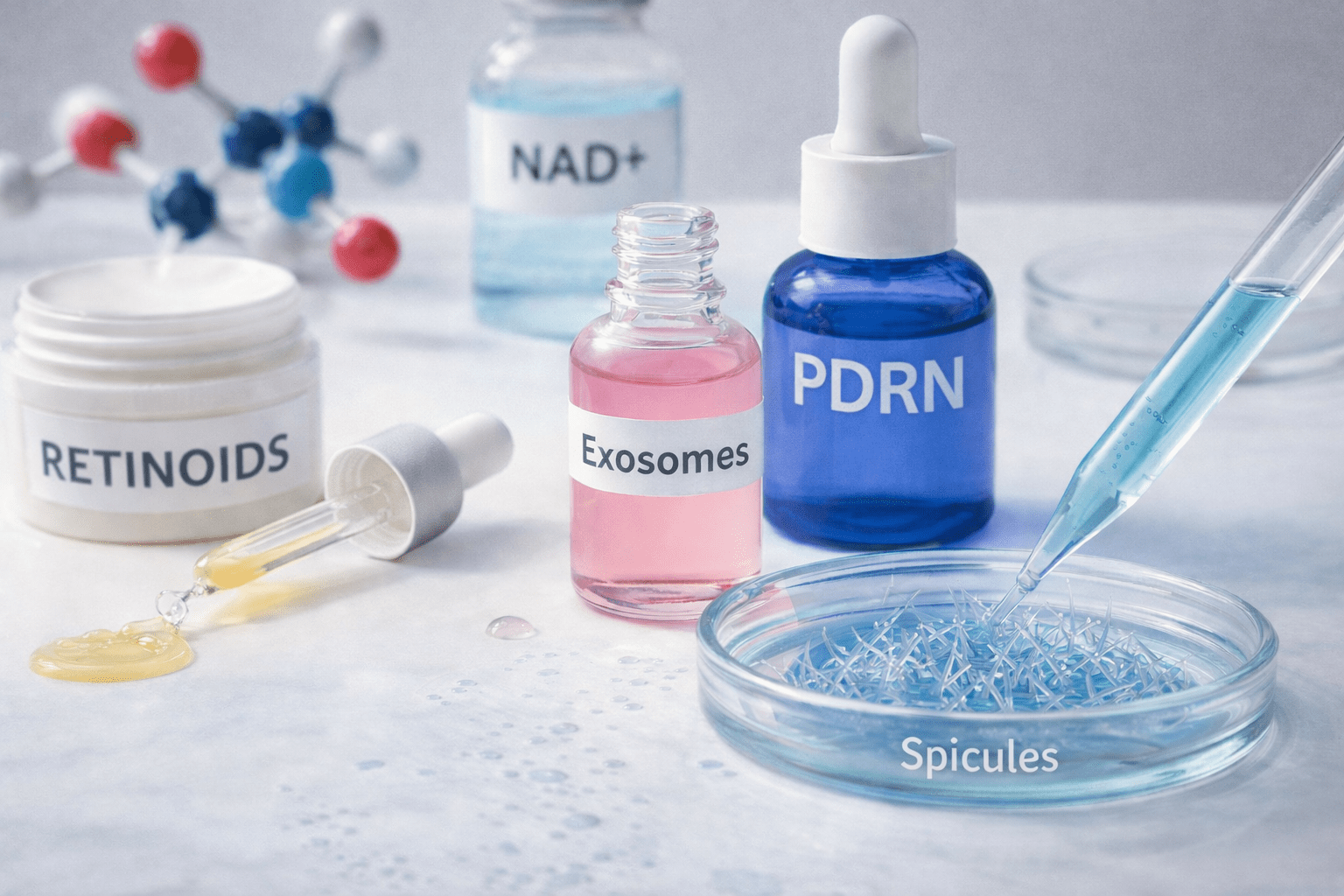
PDRN, Exosomes, NAD+, Reedle™, Spicules and Retinoids
If you follow trends in Korean skincare, you’ve probably noticed that more and more people are talking about “biotechnology-based” ingredients. PDRN, exosomes, and NAD+ are no longer reserved only for dermatology clinics — today they are also available in at-home skincare.
However, even though they all promise regeneration and anti-aging benefits, their mechanisms of action are not the same.
This guide will help you understand:
- how each ingredient works on the skin level
- who it is best suited for
- whether it can be combined with other ingredients
- how to choose based on your skin’s real needs, not just trends
PDRN – When Skin Needs Repair and Calm
PDRN (polydeoxyribonucleotide) is an ingredient derived from DNA (most commonly salmon DNA) that has long been used in dermatology to support tissue healing and regeneration.
In cosmetics it is adapted to:
- stimulate natural cell renewal
- strengthen the skin barrier
- reduce redness and sensitivity
- improve elasticity
Unlike more aggressive active ingredients, PDRN does not irritate the skin in order to work. Instead, it supports the skin and helps it regenerate naturally.
When should you use PDRN?
- after aesthetic treatments
- if your skin is dehydrated and weakened
- if your skin barrier is compromised
- if you want anti-aging care without peeling or irritation
At mikrokosmos.hr, you can find:
- salmon-derived PDRN (classic form)
- vegan PDRN (biotechnology-based alternative without animal origin)
Both versions aim to support skin regeneration, but the vegan option is designed for customers who prefer cruelty-free formulations.
For example: the salmon PDRN version from Medicube, the vegan PDRN derived from ginseng from VT Cosmetics, and many other products containing this ingredient.
Exosomes – The Skin’s “Communication System”
Exosomes are microscopic vesicles that cells use to communicate with one another. In skincare, laboratory-produced exosomes deliver signaling molecules responsible for regeneration and collagen production.
Simply put:
- PDRN supports regeneration
- exosomes signal the skin to start regeneration
Their benefits include:
- stimulation of collagen synthesis
- improved firmness and tone
- reduction of visible wrinkles
- smoother skin texture
In our offer you can find exosome products from Medicube, a brand known for clinically inspired formulations and anti-aging innovations.
Who are exosomes best for?
- mature skin
- skin with loss of elasticity
- skin showing more pronounced signs of aging
- those seeking a stronger anti-aging approach
NAD+ – The Energy That Powers Cells
NAD+ (nicotinamide adenine dinucleotide) is a coenzyme present in every cell of the human body. It plays a crucial role in energy production and DNA repair processes.
As we age, NAD+ levels decline, which may lead to:
- slower regeneration
- loss of elasticity
- tired-looking skin
In cosmetics, NAD+ acts as an energy support system for the cell.
What does that mean in practice?
- skin appears fresher
- natural renewal is stimulated
- skin tone improves
- the complexion gains a healthy glow
If exosomes are the message, NAD+ is the fuel.
Who is it for?
- tired, stress-affected skin
- dull skin lacking radiance
- people who want a preventative anti-aging approach
- skin that reacts slowly to active ingredients
We offer the NAD+ line from numbuzin.
Reedle™ and Spicules – Micro-Stimulation Without Professional Treatments
Unlike the previous ingredients, which work biologically, Reedle™ and spicules act mechanically.
The Reedle™ technology, popularized by VT Cosmetics, uses microscopic particles that create mild skin stimulation and help active ingredients penetrate deeper.
The sensation is a light tingling or prickling, which is a normal reaction.
Spicules are a natural version of the same principle (often derived from marine sponges). We offer formulations with spicules from Mary & May.
Their role is to:
- improve serum absorption
- smooth skin texture
- reduce the appearance of pores
- enhance the effectiveness of active ingredients
It is important to understand that they are not anti-aging ingredients by themselves — they help other ingredients work more effectively.
Retinol and Retinal – Classic Anti-Aging Activators
Retinoids are derivatives of vitamin A that accelerate cell renewal.
- milder form
- slower results
- fewer irritations
- ideal for beginners
- stronger form
- faster results
- can cause irritation if introduced too quickly
Unlike PDRN or NAD+, retinoids force the skin to renew itself. For this reason they require caution and daily SPF protection.
How to Choose Based on Your Skin Type
- sensitive skin, damaged barrier → PDRN
- mature skin, loss of firmness → Exosomes
- tired, dull skin → NAD+
- uneven texture and enlarged pores → Reedle™ or spicules
- wrinkles, acne, pigmentation → Retinol or retinal
Can These Ingredients Be Combined?
Yes — but gradually.
Example of an advanced evening routine:
- Reedle™ or spicules (2–3 times per week)
- serum with PDRN, NAD+, or exosomes
- moisturizing cream
- retinol or retinal (alternating days, not on the same night for sensitive skin)
- and most importantly: daily SPF protection
Conclusion
There is no universal “best” ingredient.
There is only the ingredient that best suits your skin’s condition at a specific moment.
If you’re unsure where to begin, it is usually safest to start with supportive ingredients like PDRN or NAD+, and then gradually introduce stronger activators such as retinoids.
Frequently Asked Questions (FAQ)
- Is PDRN safe for sensitive skin?Yes. PDRN is known for its soothing and regenerative properties. It does not cause peeling or irritation like retinoids or acids, which is why it is often recommended for sensitive, reactive, and damaged skin.
If your skin is extremely reactive, it is still advisable to perform a patch test before regular use.
- What is the difference between salmon PDRN and vegan PDRN?Traditional PDRN is derived from salmon DNA and has been used in dermatology for many years.
Vegan PDRN is produced through biotechnology without animal origin.
Functionally, they serve the same purpose — skin regeneration and renewal. The main difference lies in the ingredient’s origin, which matters for customers who prefer cruelty-free or vegan formulations.
- Are exosomes the same as PDRN?No.
PDRN supports regeneration and repair, while exosomes signal the skin to start regeneration and collagen production.
You can think of it this way:
- PDRN = building material
- Exosomes = the message that construction should begin
They can be combined, but they are not substitutes for one another.
- What exactly is NAD+, and is it the same as niacinamide?No, NAD+ and niacinamide are not the same.
NAD+ (nicotinamide adenine dinucleotide) is a coenzyme involved in cellular energy production.
Niacinamide is a form of vitamin B3 that affects the skin barrier, pores, and pigmentation.
Although they are related in biochemical processes, they have different roles in skincare.
NAD+ focuses on cellular energy and anti-aging support.
- Can I use Reedle™ or spicules if I have sensitive skin?Yes, but with caution.
Reedle™ and spicules create mild micro-stimulation and a tingling sensation. If your skin barrier is very sensitive or damaged, it is better to stabilize the skin first (for example with PDRN) before introducing stimulation.
Always start with a gentler version and use 1–2 times per week.
- Can I combine retinol or retinal with PDRN or NAD+?Yes — and this can actually be a very beneficial combination.
Retinoids accelerate cell turnover, while PDRN and NAD+ help the skin regenerate more easily and reduce irritation.
Example:
- Evening: retinol
- follow with a serum containing PDRN or NAD+
- apply moisturizer
If you have sensitive skin, avoid combining retinoids and Reedle™ technology on the same night.
- When will I see the first results?It depends on the ingredient:
- PDRN → calming and hydration often visible within 1–2 weeks
- NAD+ → improved radiance and vitality within a few weeks
- Exosomes → visible anti-aging effects typically after 4–8 weeks
- Retinol/retinal → first changes after 4 weeks, full effect after 8–12 weeks
Consistency is key.
- Do I need SPF when using these ingredients?Yes — especially if you use retinol, retinal, or Reedle™.
Sun protection is essential to prevent additional skin damage and maintain the results of your skincare routine.
- Which ingredient is best for beginners?If you are just entering the world of advanced skincare ingredients:
- start with PDRN or NAD+
- then introduce exosomes
- add retinol gradually
- use Reedle™ or spicules only once the skin barrier is stable


